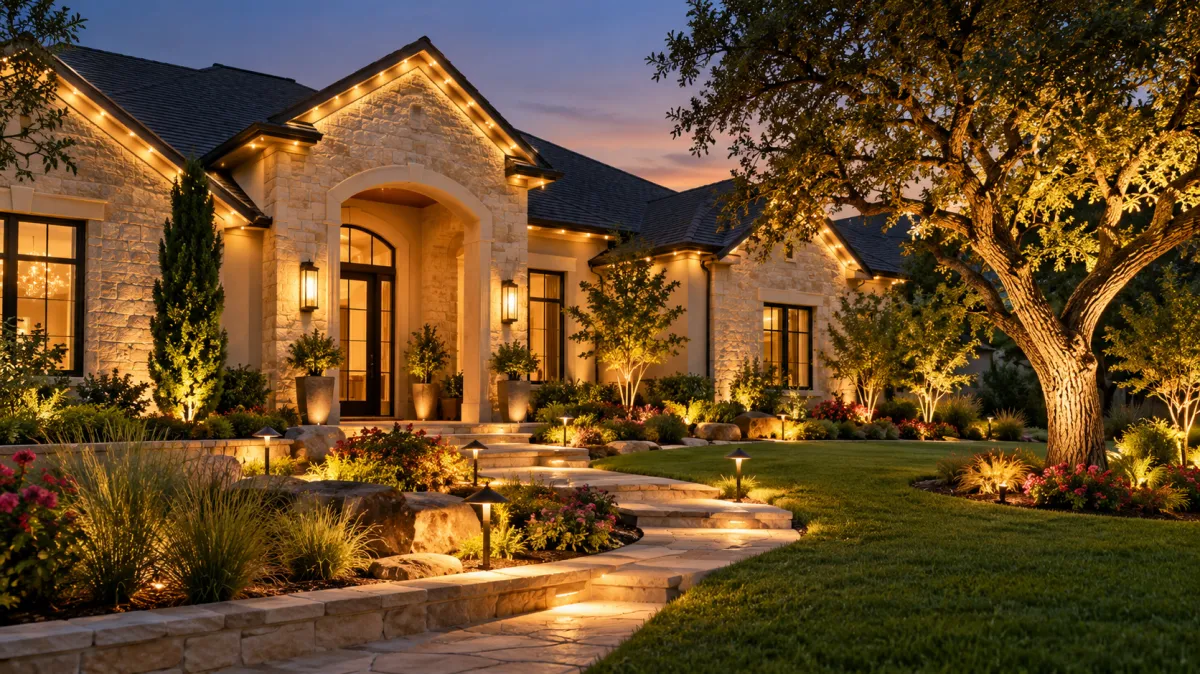
Layered Outdoor Lighting: Roofline, Entry, and Landscape
A home can have plenty of exterior lights and still feel difficult to read after dark. The roof may be outlined brightly while the front step disappears. A tree may be beautifully illuminated while the entrance feels lost behind it. Layered outdoor lighting solves this design problem by giving each part of the property a specific job.
For San Antonio homeowners considering permanent roofline lighting, the most useful question is often what should happen below the roof. A coordinated entry, walkway, and landscape can make the overall scene feel complete without making every surface equally bright.
Start with the route people actually use
Walk from the usual arrival point to the front door after dark. Include the driveway, the public sidewalk where accessible, and any change in direction near the porch. Note where you hesitate or have to search for an edge. These observations are more useful than deciding you need a certain number of fixtures.
The route may not follow the most photogenic part of the yard. Guests might approach from a side gate, park near a garage, or cross a short landing before reaching the porch. Describe those habits during the design visit so practical lighting is placed around real movement.
Also look back from the door. A light source that seems comfortable when approaching can become glaring on the way out. The arrival and departure views both belong in the plan.
Use the roofline to establish the frame
Permanent roofline accents can describe the larger shape of the home. They provide a visual frame and can carry a seasonal palette. They do not automatically provide adequate light at ground level, particularly beneath deep overhangs or behind planting beds.
Decide how much of that frame you want to see. A single principal roof edge may be enough for a compact elevation. A deeper property might benefit from selected returns that make its shape clear from a diagonal approach. Keeping this layer restrained leaves room for the entry and landscape to contribute.
An everyday scene can be quieter than a holiday scene. Ask how the proposed system would support the desired look, including any separate control of sections. The available options depend on the installed products and configuration.
Make the entry easy to recognize
The entrance usually needs a more direct relationship with people than the roofline does. Visitors should be able to recognize the door, read the address where practical, and see the transition onto the porch. Decorative color can surround this area while the immediate approach remains on a useful steady setting.
Existing porch lanterns may already do part of the job. Review their effect before adding fixtures. Sometimes an overly bright source competes with the whole composition; sometimes the fixture lights its own glass more than the landing beneath it. Discuss the actual result rather than assuming an attractive fixture provides the right light.
Choose a limited landscape focus
A mature tree, a textured wall, or a distinctive planting bed can add depth beyond the building. Choose the feature that contributes most to the view. Lighting every shrub with equal emphasis tends to flatten the scene and makes it harder to know where to look.
Landscape lighting should be aimed and adjusted for the target. A fixture intended to highlight a tree should not casually spill into the sky or a nearby window. Ask the designer to review shielding, direction, and the lowest useful brightness for the intended effect.
Leave some parts of the yard dark. Those quieter areas help separate the illuminated features and preserve the sense of an outdoor setting. DarkSky and the Illuminating Engineering Society’s responsible lighting principles offer a helpful framework for purposeful placement and controlled use.
Balance the layers together
Review the complete scene with the existing lights switched on as they normally would be. A roofline demonstration viewed alone can be misleading if porch lanterns, driveway lighting, and landscape accents will operate at the same time.
Try reducing the strongest layer before adding brightness elsewhere. If the tree dominates the house, lower its emphasis. If the roofline overwhelms the entrance, adjust the relationship between them. The aim is a readable sequence from property edge to front door, with decorative features supporting that sequence.
Repeat the review from a main indoor window. You may value a softly illuminated tree from the living room more than a feature that is visible only from the street. A good layered plan can acknowledge both experiences.
Prioritize the project in phases
If the full plan will be installed over time, begin with the most important practical need and identify how later layers will fit. Ask about placement and access requirements before landscaping or hardscape changes make adjustments more difficult.
Request an outdoor lighting design consultation with Infinity Outdoor Lighting. Bring a photograph of your San Antonio-area property and describe the route, entry, and landscape features you want the evening view to reveal.
Image: Illustrative lighting design concept; not a completed customer project.
